Showing posts with label is. Show all posts
Showing posts with label is. Show all posts
Wednesday, February 22, 2017
The Reason Why Video Entertainment is The Only Service To Increase Prices
The Reason Why Video Entertainment is The Only Service To Increase Prices
Over the past several decades, it would have been a reasonable question to ask why entertainment video service prices grew faster than inflation, while retail prices for communications services (voice, texting, Internet access) declined, either on a price-per-unit basis or in terms of absolute price per unit.
The answer is simple: entertainment video is about the purchase of content, not access to content.
Compared to voice, texting or Internet access, entertainment video is more akin to fashion than a utility service. And that means retail price is not a direct function of production cost.
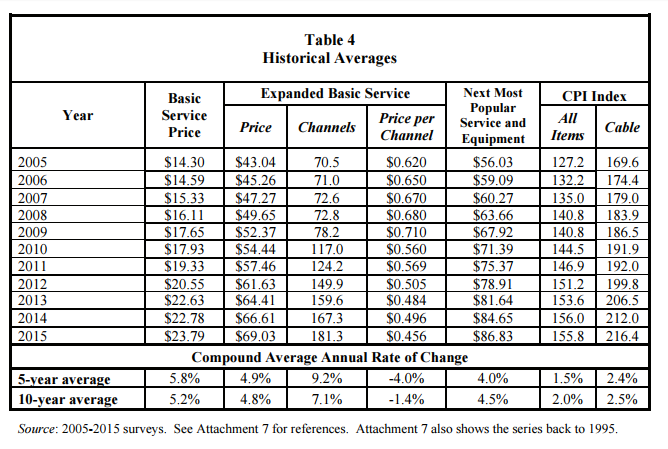
That is clear in the latest Federal Communications Commission report on content prices in the U.S. linear video market.
However, given diminished consumer appetite for the traditional “big content bundles” and a shift to over-the-top or on-demand viewing, it will be necessary for most, if not all, providers to “just say no” to content providers and restrict the size of bundles.
That is going to shift the way content gets to market, with increasing amounts of programming moving through new services such as Netflix and Amazon Prime.
According to a new FCC report, the average monthly price of expanded basic service (the combined price of basic service and the most subscribed cable programming tier excluding taxes, fees, and customer premises equipment charges) for the communities surveyed grew by 2.7 percent over the 12 months ending January 1, 2015, to $69.03, compared to a decrease of 0.1 percent in the consumer price index.
That is to say, linear video prices rose by an order of magnitude more than the overall level of consumer prices.
This compares to a compound ten-year average rate of increase from 2005 to 2015 of 4.8 percent in the price of expanded basic and a 1.5 percent increase in the CPI.
To be sure, linear video providers have argued in the past that prices are up in large part because the number of channels offered in bundles has grown.
The price per channel (price divided by number of channels) for subscribers purchasing expanded basic service decreased by 1.8 percent over the 12 months ending January 1, 2015, to 46 cents per channel.
Over the 10 years from 2005-2015, the price per channel has declined by 1.4 percent on an average annual compound basis.
In the past, consumers might not have had as much choice. In the future, they will. Prices are going to come down. Still, the issue is whether entertainment video might still outperform voice, texting or Internet access, in some cases, in terms of absolute revenue contribution, price per unit or profit margin.

source: FCC
Available link for download

Tuesday, February 21, 2017
2014 Lexus IS F350 STANCE Car Mod for GTA SA Android
2014 Lexus IS F350 STANCE Car Mod for GTA SA Android

CREDIT
Author Model : Fire Monkey
Converted from game Real Racing 3 to GTA : San Andreas by Abdulloh Al Atthos.
FITURE
- Working Damage Parts
( Boot,Bonnet,Bumper,Door)
- SA Lights
MORE SCREENSHOT


DOWNLOAD
Link : DOWNLOAD
Password : gtamodrr3
CARA PASANG
1. Buka tool Spark, IMG Tool, atau Alcis IMG untuk membuka gta3.img
2. Open gta3.img yang ada di dalem folder texdb
3. Replace dff nya
4. SAVE / REBUILD ARCHIVE
5. Buka TXDF*cker
6. Open gta3.txt yang ada didalem folder texdbgta3
7. Pilih import with alpha & Import without Alpha ( Sudah di pisahkan dimasing masing folder )
8. tunggu sampai selesai. (Jika not responding, itu tandanya sedang proses import )
9. Jika sudah tutup TXDF*cker nya dan mainkan gamenya.
Enjooy ^_^
NOTE
- Dilarang keras convert mobil ini dijadikan DFF Only (DFFO)
- Dilarang keras memasukan mod mobil ini kedalam modpack tanpa ijin dari Author.
- Dilarang Reupload mod ini ke blog atau website manapun.
Available link for download
Tuesday, February 14, 2017
It Has Taken a Couple of Decades but Fixed Wireless is Coming Back in a Big Way
It Has Taken a Couple of Decades but Fixed Wireless is Coming Back in a Big Way
Windstream plans to expand its fixed wireless access operations in 40 U.S. markets, using 39-GHz millimeter wave spectrum, presumably for backhaul and business customer access.
Ironically, Windstream in 2008 wrote down the value of its 39 GHz spectrum holdings to zero, as part of a sale of mobile and wireless assets to AT&T Mobility.
The collapse of a millimeter-wave access services business is not terribly unusual. Whole companies (Windstar and Teligent, for example) went bankrupt after trying to build an enterprise access business using millimeter wave technology, after the passage of the Telecommunications Act of 1996.
But times change. Platforms become more capable. Costs go down. And with coming 5G mobile networks embracing millimeter wave technology, what was a broken business model two decades ago might well become an essential underpinning of next generation networks, both mobile and fixed.
Google Fiber, Facebook, AT&T and Verizon are a few of the leading firms now developing or planning to use fixed wireless in a significant way for Internet access.
Cambridge Broadband Networks (CBNL) is providing the radios and and Straight Path Communications is supplying the spectrum licenses for the Windstream rollout.
The new technology will allow Windstream customers data speeds of up to 275 Mbps full duplex, and it also supplements Windstreams other fixed wireless access technologies that range in speed from 1 Mbps to 1 Gbps.
Windstream will deploy in seven existing markets where it currently offers fixed wireless access technology - Chicago, New York City, Boston, Cleveland, Philadelphia, Milwaukee and Little Rock using equipment from CBNL and spectrum from Straight Path.
Windstream will also deploy CNBL equipment in 33 new markets where it will begin offering its fixed wireless technology. Those markets include Atlanta, Baltimore, Charlotte, Cincinnati, Dallas, Detroit, Kansas City, Miami, Minneapolis,Nashville, Oklahoma City, Phoenix, Richmond, San Antonio, Seattle and St. Louis.
Under the agreement, Windstream has the option of eventually expanding fixed wireless to an additional 32 markets where Straight Path owns 39 GHz spectrum.
Available link for download
Tuesday, February 7, 2017
Is there a competition law issue lurking on the horizon of cloud computing
Is there a competition law issue lurking on the horizon of cloud computing
In 2006, Amazon made available a beta version of a service called “Elastic Compute Cloud”, described as

As such, AWS early on enjoyed first mover advantage (being the first cloud computing service “to succeed on a large scale”) and continues to benefit from network effects. As well, the burden of switching costs served to make it more likely that a user will be reluctant to move to another cloud service. Based on these advantages, AWS has raced far ahead of its competition. It is three times larger than its nearest competitor—Microsoft Azure. Other potential competitors are even less visible, including competing offerings from IBM and Google. At least these two hi-tech behemoths are still in the game; Hewlett-Packard has apparently simply withdrawn from the field. Even Salesforce.com, which is a prominent provider of on-line applications, announced that it will begin to make use of AWS services.
What will slow AWS’s continued dominant position in the industry? The article suggests that users are aggressive in trying to avoid being locked-in to AWS as their sole cloud services provider. It further reports that, at least in Europe, two-fifths of the companies in the cloud use more than one cloud service. Also, while the AWS service is highly popular with start-up developers, it has less success in attracting larger, established companies, in part, it would seem, from a hesitation by such companies to be tied up with a potential competitor, given the ever-increasing nature of Amazon’s product and service offerings. These countervailing forces argue that there may be a limit as to how much more AWS can grow.
Still, based on the information in the article, AWS does seem to enjoy a dominant position with smaller developers. If this were to be found to be the relevant population for vetting competition law concerns, then attention to pricing (should prices begin to tick upwards) and the ease or difficulty of switching to another cloud service, bears watch, especially since the computing infrastructure required might serve as a potential barrier to entry for competitors. Or perhaps less conventional metrics will be brought to bear. The article itself does not go into a discussion of how anti-competitive behavior by AWS might look, stating merely that—
“AWS could end up dominating the IT industry just as IBM’s System/360, a family of mainframe computers, did until the 1980s. If that happens, the antitrust authorities may eventually have to step in, as they did with IBM.”

Even more, this Kat remembers the frequently made comment that antitrust suits such as the IBM case, especially in the technology area, are almost always late to the game: either the technology is passing the target industry by, or the law suit is a cue to the target to seek new products and markets. If this be true, then it raises an interesting question: what would the filing of such a law suit say about the cloud-computing industry? Is the pace of innovation so seriously stuck in neutral, and the nature of cloud-computing so very different from the world of IBM’s System/ 360 family of mainframe computers, that there might be greater justification in considering such a law suit, should there be prima facie indicia of anti-competitive behavior? Or will such a suit be a redux of the IBM litigation? Stay tuned (especially if your computing connectivity is from the cloud).
Available link for download
How To Know If Your Smartphone is 4G LTE Supported
How To Know If Your Smartphone is 4G LTE Supported
Most of the telecommunications in Nigeria are now migrating from existing 2G and 3G services to genuinely high-speed mobile broadband on 4G/LTE and this is time for us to dump outdated 3G network and moves forward with 4G LTE network.

4G LTE allowed smartphone technology to spread its wings. That’s because it’s much, much faster than 3G. So when you want to download the new game or stream a TV show in HD, you can do it without buffering and legs that make the experience not worth the wait.Using a 4G smartphone with 4G LTE network means you can download files from the Internet up to 10 times faster than with 3G.
Based on peoples comments in the previous post about 4G LTE, we noticed that lots of people cant different if their smartphone is 3G or 4G enabled device, now we are here to sort it out.
Whether you are using Android smartphone, iPhone, Windows Phone or even a Blackberry device, you can check if that your mobile phone support 4G network. The steps are very simple, just follow it accordingly.
To Know If Your Smartphone is 4G LTE Supported
For Android Device
Go to Settings >> Network Settings >> Mobile Network. It should give you a drop-down menu of mobile standards such as 2G, 3G or LTE (4G). If you don’t see 4G or LTE, then your smartphone doesn’t support the standard.

iPhone Users
Go to Settings >> General >> Cellular >> Enable 4G LTE.
Blackberry Users
Go to settings >> Network and Connection >> Mobile Network >> Network mode and you’ll see 4G&3G&2G. however, if you are using Blackberry Q5 and below, you won’t get 4G network services.
Windows Phone Users
Go to Settings > Celluar + Sim > Highest connection speed and check if LTE is part of the options.
Available link for download
Subscribe to:
Posts (Atom)