Showing posts with label service. Show all posts
Showing posts with label service. Show all posts
Sunday, February 26, 2017
How Many Service Providers Can Escape Dumb Pipe Status
How Many Service Providers Can Escape Dumb Pipe Status
One universally hears service provider executives arguing they want to avoid becoming “dumb pipe” connectivity providers. What is not so clear is how many service provider entities will actually be able to do so in a significant way.
For many--perhaps most--suppliers, being an efficient dumb pipe provider is possibly the only viable path forward. The problem is that most proposed new services and applications require scale.
Whether it is entertainment video, mobile banking and payments, connected car, connected health or other Internet of Things apps, viable suppliers must achieve scale. Almost by definition, most smaller providers will be unable to do so.
That will mean an industry dominated by http://howtomonetizeeverything.blogspot.com /2016/10/by-2025-as-few-as-110-telecom-service.html" style="text-decoration: none;">10 global service providers, some predict. Those handful of firms can become branded suppliers of applications. Smaller providers will struggle to reduce costs enough to remain viable primarily as suppliers of access services.
In other words, the advice to “move up the stack” will be viable for a relative handful of firms. Most service providers will focus primarily on access. In the Internet era, that means being suppliers of “dumb pipe” Internet access.
Moving “up the stack” will be necessary and possible for the webscale global giants. Beyond some limited scenarios, smaller providers will lack the scale to create viable new application or services.
Available link for download

Wednesday, February 22, 2017
The Reason Why Video Entertainment is The Only Service To Increase Prices
The Reason Why Video Entertainment is The Only Service To Increase Prices
Over the past several decades, it would have been a reasonable question to ask why entertainment video service prices grew faster than inflation, while retail prices for communications services (voice, texting, Internet access) declined, either on a price-per-unit basis or in terms of absolute price per unit.
The answer is simple: entertainment video is about the purchase of content, not access to content.
Compared to voice, texting or Internet access, entertainment video is more akin to fashion than a utility service. And that means retail price is not a direct function of production cost.
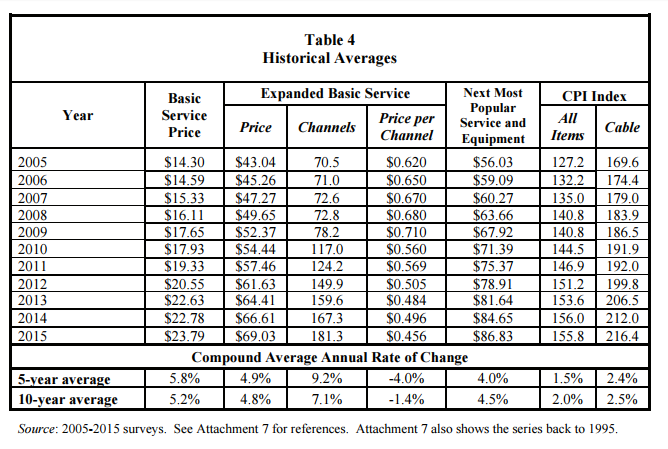
That is clear in the latest Federal Communications Commission report on content prices in the U.S. linear video market.
However, given diminished consumer appetite for the traditional “big content bundles” and a shift to over-the-top or on-demand viewing, it will be necessary for most, if not all, providers to “just say no” to content providers and restrict the size of bundles.
That is going to shift the way content gets to market, with increasing amounts of programming moving through new services such as Netflix and Amazon Prime.
According to a new FCC report, the average monthly price of expanded basic service (the combined price of basic service and the most subscribed cable programming tier excluding taxes, fees, and customer premises equipment charges) for the communities surveyed grew by 2.7 percent over the 12 months ending January 1, 2015, to $69.03, compared to a decrease of 0.1 percent in the consumer price index.
That is to say, linear video prices rose by an order of magnitude more than the overall level of consumer prices.
This compares to a compound ten-year average rate of increase from 2005 to 2015 of 4.8 percent in the price of expanded basic and a 1.5 percent increase in the CPI.
To be sure, linear video providers have argued in the past that prices are up in large part because the number of channels offered in bundles has grown.
The price per channel (price divided by number of channels) for subscribers purchasing expanded basic service decreased by 1.8 percent over the 12 months ending January 1, 2015, to 46 cents per channel.
Over the 10 years from 2005-2015, the price per channel has declined by 1.4 percent on an average annual compound basis.
In the past, consumers might not have had as much choice. In the future, they will. Prices are going to come down. Still, the issue is whether entertainment video might still outperform voice, texting or Internet access, in some cases, in terms of absolute revenue contribution, price per unit or profit margin.

source: FCC
Available link for download
Monday, February 13, 2017
Sprint Sprint Foundation to Make Free Mobile Service Available to One Million High School Students
Sprint Sprint Foundation to Make Free Mobile Service Available to One Million High School Students
Sprint and the Sprint Foundation will help change the lives of one million high school students by giving them free mobile devices and free Internet access.
The One Million Project is supported in part by device donations from handset suppliers. Sprint and the Sprint Foundation will raise funds through special events, donation drives and other activities aimed at employees and customers, as well as company-owned, dealer, and national retail stores across the country.
Sprint will work with non-profit agencies including EveryoneOn and My Brother’s Keeper Alliance which will help to recruit community organizations such as schools, libraries, public-housing authorities, and non-profits to deliver the devices and activate the mobile internet service, usable by students for up to four years in high school.
Each student may receive either a free smartphone, tablet, laptop or hotspot device and 3GB of high-speed LTE data per month.
Unlimited data is available at 2G speeds if usage exceeds 3GB in a month. Those who receive a smartphone can use it as a hotspot and for unlimited domestic calls and texts while on the Sprint network.
Available link for download
Subscribe to:
Posts (Atom)