Showing posts with label are. Show all posts
Showing posts with label are. Show all posts
Monday, February 13, 2017
Average U S Internet Access Speeds are Highly Dynamic
Average U S Internet Access Speeds are Highly Dynamic
If in the second quarter of 2016, average connection speeds in U.S. cities ranged from 17 Mbps to 24 Mbps, while Internet service providers are selling gigabit access, as well as services in the 100 Mbps to 300 Mbps range, it is obvious that most consumers are not buying either gigabit or hundreds-of-megabits services.
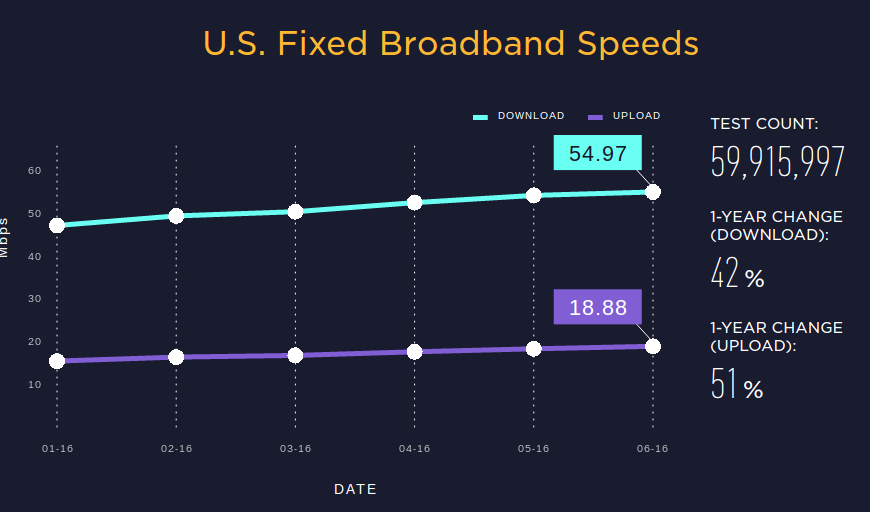
On the other hand, speeds are increasing rapidly. In fact, according to Okla, fixed network customers in the first half of 2016 got an average of over 50 Mbps for the first time ever.
That represents a speed improvement of more than a 40 percent since July 2015.
Similarly, mobile Internet access customers saw speeds improve by more than 30 percent since last year, with an average download speed of 19.27 Mbps in the first six months of 2016.
In other words, by some measures, mobile Internet access download speeds are as fast, or nearly as fast, as the “average” U.S. fixed network connection in at least some cities.
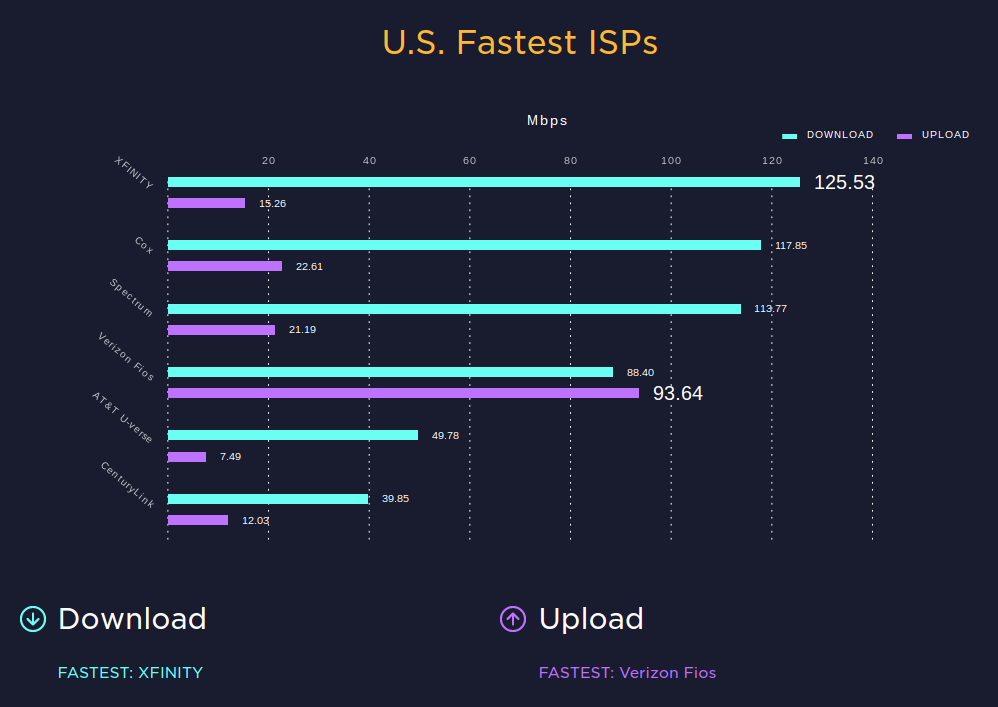
Just as important are http://howtomonetizeeverything.blogspot.com /2016/08/over-15-years-average-internet-speed.html" style="text-decoration: none;">speed differences between various ISPs. Where Google Fiber might offer an average speed in excess of 300 Mbps, Comcast and other cable TV ISPs might average about 50 Mbps to 45 Mbps. Telcos tend to deliver slower speeds than that, with the exception of Verizon FiOS, which has an average speed of about 50 Mbps.
source: Ookla
source: Ookla
Available link for download

Thursday, January 19, 2017
Are Webscale App Providers Shaping Core Telecom Platform Trends
Are Webscale App Providers Shaping Core Telecom Platform Trends
Webscale Internet companies (Google, Apple, Facebook, Microsoft and Amazon) now are exerting a “markedly increased influence” on markets for communications service. Analysts at Heavy Reading now think the webscale players also increasingly are shaping the market for networking hardware, software and services.
That will be a contentious point of view, even if many telecom industry execs and others think that is true, to some extent.
Google and Facebook are developing new backhaul and access platforms. Google Fiber does buy industry-standard optical access networks as well.
But Facebook mostly is looking at open source platforms that can be manufactured by supplied by industry suppliers.
Clearly, there is impact in terms of buying behavior in the case of Google Fiber, and development potential in the open source efforts by Facebook.
At least some telecom industry professionals believe the webscale providers are "leading in networking innovation"; are "increasingly calling the shots"; increasingly "building out their own telecom infrastructure" and that "its a matter of time before one of these guys buys one of the big CSPs (communications service providers).”
A Heavy Reading analyst team interviewed more than a dozen leading network infrastructure professionals at leading CSPs at the CTO, VP and director level, as well as more than 25 senior individuals in network equipment vendors at CTO, VP and director level; plus several leaders in key telecom industry associations, standards bodies and other specialist consultancies; and some of the WICs themselves.
The primary and secondary research was complemented by a Heavy Reading online survey, generating responses from 82 qualified respondents in network equipment vendors and 57 from qualified respondents in CSPs.
Keep in mind that about half the 82 vendor respondents came from individuals from one vendor company.
Around half came from vendors from whom two or more (but no more than four) respondents supplied responses. Those companies from which two or more respondents participated include ADVA, Broadsoft, Casa Systems, Cisco Systems, Ericsson, F5, Huawei, HP, IBM, Infinera, Juniper Networks, Nokia, NetScout, Vasona Networks and Radisys.
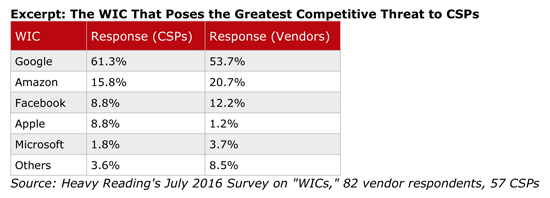
As you might expect, the online respondents identified Google as the webscale player posing the greatest threat to communications service providers.
Source: Heavy Reading
Available link for download
Subscribe to:
Posts (Atom)